Steampunk Gear Frame SVG Bundle
A Designer’s First Look: Gears That Feel Like a Conversation Starter
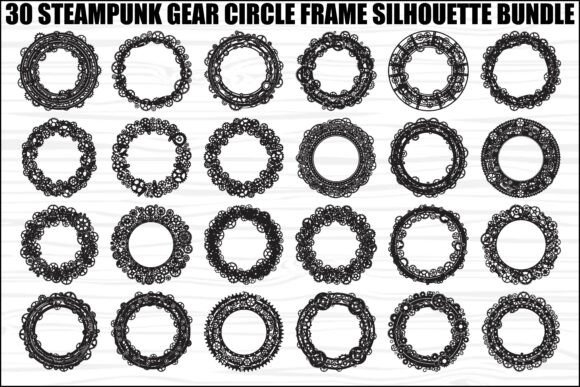
Unzipping the Steampunk Gear Frame SVG Bundle, I didn’t just see 30 circular frames—I saw 30 potential story hooks. Each design balances mechanical precision with vintage charm: overlapping cogs, asymmetrical bolt clusters, layered gear silhouettes, and subtle rivet textures that imply weight and history. This isn’t steampunk as costume prop—it’s steampunk as quiet confidence. The circular format gives immediate structure, making it ideal for center-placement embroidery where clarity and balance matter more than chaos.
Where It Lives Best: Real Projects, Not Just Pixels
Last week, I prepped a custom embroidered tote bag for a local indie bookstore—part of their “Maker’s Corner” launch. They wanted something that whispered “handmade ingenuity,” not screamed “steampunk convention.” I chose one of the mid-weight designs from the Steampunk Gear Frame SVG Bundle: clean outer ring, three visible gears at 12, 4, and 8 o’clock, minimal interior clutter. Stitched on natural canvas with matte charcoal thread, it landed exactly right—detailed enough to reward a second glance, restrained enough to avoid visual fatigue. Customers kept asking, “Is that *all* gears? How did you get the spacing so even?” That’s the sign of a working design: it sparks curiosity without confusing.
It also translated beautifully onto a heavyweight unisex sweatshirt—center-chest placement, 4.5" diameter. The frame held its shape across the knit’s slight give, and the satin-stitched gear edges stayed crisp. For baby embroidery? I’d lean toward the simpler frames in the bundle—those with fewer nested cogs and bolder negative space. One design with a single large central gear and two flanking bolts stitched cleanly on organic cotton onesies using lightweight cutaway stabilizer and 40-weight thread. No puckering. No lost detail.
Where to Pause—and Why
This bundle shines on stable, medium-to-heavy fabrics: canvas, denim, twill, tea towels, pillow covers, and structured aprons. But it asks for attention on trickier surfaces. On stretchy jersey or thin voile, the tighter fill-stitch areas (especially around small bolt heads or gear teeth) can distort or tunnel without precise stabilizer pairing—test with tear-away + light cutaway first. Curved surfaces like caps demand careful hooping and possibly reduced stitch density in outer arcs; some frames have fine inner rings that may blur if compressed.
Dark fabric is where contrast becomes critical. A design with tight interlocking gears loses legibility in black-on-black thread. I ran quick black-and-white mockups before committing—and swapped to heather gray thread on navy twill for better definition. Also worth noting: while these are Illustrations built for digital use, they’re not automatically optimized for dense machine embroidery. If your embroidery file conversion adds excessive underlay or overfills narrow gear spokes, the final stitchout may feel heavy or rigid. Always inspect the converted file—not just the SVG preview.
Design Integrity Meets Customer Trust
When a customer orders a personalized gift—a holiday mug cozy, a wedding apron, a boutique nursery pillow—the Steampunk Gear Frame SVG Bundle doesn’t just decorate. It signals care. Clean lines say “this was chosen, not tossed in.” Balanced weight distribution says “it’ll hold up.” And because each frame feels intentional—not repetitive or algorithmically generated—it supports brand consistency for Etsy sellers and small shop owners building a recognizable handmade aesthetic.
I’ve seen too many craft businesses dilute their voice with generic clipart-style gears. These frames avoid that trap. They carry personality without shouting. That translates directly to buyer engagement: longer dwell time on product photos, higher add-to-cart rates on items featuring them, and repeat requests for “more like that gear circle.”
Practical Notes from the Hoop
- Always test first—not just on scrap fabric, but on the *exact* fabric + stabilizer combo you’ll use. Gears reveal tension issues faster than almost any motif.
- Check thread color contrast early. Metallics look luxe on dark backgrounds, but matte bronze or gunmetal often reads richer and holds up better in washing.
- Review stitch density manually. Some frames include delicate interior flourishes—run a visual pass to spot areas where fill stitches might crowd running-stitch outlines.
- Confirm hoop size compatibility. Most frames scale well, but the most intricate ones hit 5.5–6" at full size—verify your machine’s max hoop before scaling up.
- Inspect small details at 200% zoom. Tiny bolt centers or gear tooth gaps should remain open in the embroidery file—not collapsed into solid fills.
- Test both light and dark fabric mockups. What reads as elegant on ivory linen may vanish on charcoal chambray without thread adjustment.
- Use appropriate stabilizer. Medium cutaway for knits, tear-away for stable wovens, fusible for lightweight linens—don’t assume one fits all.
- Verify licensing terms. As Graphics, these files may be licensed for commercial embroidery use—but confirm whether finished physical products (like embroidered patches or tote bags) and digital resale (as part of a larger design pack) are permitted.
Final Thought: A Frame That Frames Your Intent
The Steampunk Gear Frame SVG Bundle isn’t background noise. It’s a deliberate compositional anchor—a way to say “this matters” without saying a word. Whether you’re stitching a one-off personalized gift or building a cohesive line of craft business merchandise, it offers restraint, rhythm, and quiet craftsmanship. It doesn’t try to do everything. It does one thing very well: give your embroidery project a centered, confident, mechanically poetic heartbeat. And in a market flooded with frantic, overworked designs, that kind of clarity is rare—and commercially valuable.