Cute Puppy Puppet and Kitten Theater Graphics
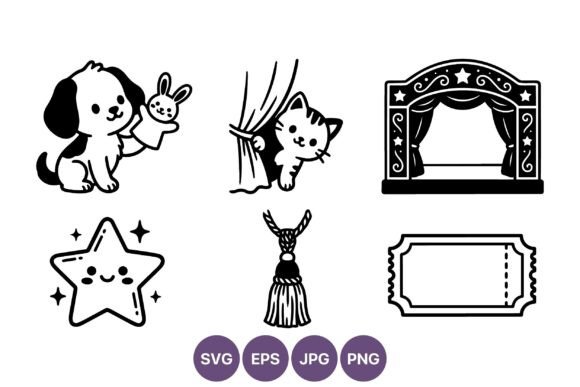
As a graphic designer who’s built brand identities for over a dozen handmade businesses—from Etsy toy shops to seasonal pop-up theaters—I opened Cute Puppy Puppet and Kitten Theater expecting whimsy. What I got was something more precise: a tightly composed, black-and-white vector illustration that balances narrative charm with commercial versatility. It shows a cheerful puppy holding a bunny puppet, a curious kitten peeking from behind a draped curtain, a stylized theater stage with tassels and framing arches, a smiling star overhead, and a clean blank ticket icon at the base. No color noise. No visual clutter. Just expressive line work, intentional negative space, and a clear theatrical motif.
A Mood That Sells Story, Not Just Style
This isn’t generic clipart—it’s a graphic design asset built for emotional resonance. The illustration leans into gentle nostalgia and playful innocence, making it ideal for client projects rooted in childhood education, indie publishing, boutique baby goods, or small-theater marketing campaigns. I recently used a similar concept for a local storytelling festival’s poster series—and realized Cute Puppy Puppet and Kitten Theater would’ve elevated the entire visual system. Its tone supports warmth without sacrificing polish, which is rare in mass-market Illustrations.
Where It Shines in Real Client Work
In practice, this asset performs strongest where personality and thematic cohesion matter most:
- Printable design for nursery wall art, storytime activity kits, or classroom posters—its high-contrast lines hold up beautifully on matte paper and vinyl cutters.
- Packaging design for handmade puppet kits, organic pet treats, or subscription boxes—the theater stage element creates instant visual rhythm on labels and mailer wraps.
- Social media graphics and Canva templates for small business owners launching themed product drops (e.g., “Puppet Palooza” spring collection).
- Cricut project files for fabric appliqués, iron-on transfers, or custom tote bags—especially when layered with soft pastel backgrounds or textured substrates.
- Product mockups for print-on-demand sellers: it scales cleanly across mugs, stickers, and enamel pins without losing legibility or charm.
- Editorial design in children’s book blogs or parenting newsletters—where its expressive characters add visual storytelling without competing with body text.
Where to Use It With Intention
This isn’t a universal drop-in solution. Its hand-drawn theatricality means it should be used carefully in contexts demanding strict neutrality or ultra-minimalist hierarchy. Avoid placing it in:
- Small-scale applications like favicon icons or app interface elements—details like the tassel or ticket icon blur below 48px.
- Crowded layouts with dense typography or overlapping patterns—it needs breathing room to land its emotional cue.
- Corporate branding systems (e.g., law firms, fintech dashboards) where tonal alignment matters more than narrative flair.
- Low-contrast backgrounds (e.g., light gray on off-white)—always test against your final substrate.
Design Judgment: How It Shapes Perception
When integrated thoughtfully, Cute Puppy Puppet and Kitten Theater elevates brand consistency by anchoring a cohesive theme—not just “cute,” but “imaginative, gentle, and intentionally crafted.” It strengthens visual hierarchy when used as a hero graphic above a headline, guiding the eye while reinforcing message intent. For a handmade business, it signals care and attention to detail; for a digital seller, it adds perceived value to a digital product bundle. Most importantly, it boosts audience engagement: parents pause longer on Instagram posts featuring this kind of illustrated storytelling, and educators save printable versions for classroom use.
Practical Designer Notes Before You License
Before deploying this in a client project, run these checks:
- Test it in pure black and white—no grayscale. Does the star still read as “smiling”? Does the curtain fold retain depth? This confirms strong silhouette integrity.
- Preview on both light and dark backgrounds. The vector’s clean outlines mean it’ll likely work on either—but verify tassel definition and ticket shape clarity.
- Scale it down to 150px wide and up to full-width web hero size. Does the puppet’s expression hold? Does the stage framing stay balanced?
- Drop it onto real product mockups: a kraft paper gift tag, a ceramic mug, a folded invitation. Context reveals what the asset truly delivers.
- Confirm file formats included. If SVG is present, check node cleanliness for easy recoloring. If PNG is provided, inspect transparency edges—no fringing on the curtain or star.
- Pair it with fonts: it harmonizes with rounded sans serifs (like Quicksand), friendly scripts (like Pacifico), and warm display fonts—but can clash with rigid geometric typefaces unless intentionally contrasted.
- Verify commercial license scope. Does it cover sublimation design, resale on POD platforms, and inclusion in Canva templates? Never assume—read the fine print.
Final Verdict: A Strategic Creative Asset, Not Just Clipart
Cute Puppy Puppet and Kitten Theater stands out in the crowded creative marketplace because it bridges aesthetic appeal and functional flexibility. It’s not background filler—it’s a commercial design tool that helps small business branding feel human, memorable, and thematically unified. Whether you’re designing for an Etsy toy shop’s holiday campaign, building a sticker design collection for crafters, or crafting marketing visuals for a community children’s theater, this illustration delivers narrative weight without sacrificing scalability or professionalism. As a working designer, I’d reach for it first when the brief calls for heart—not hype.